Gas Mask Riot Control Protection for Duty Use
A crowd-control respirator is only useful when it seals, carries the correct approved cartridge, and remains usable under pressure. For gas mask riot control assignments, the purchase decision is not about choosing the most aggressive-looking mask. It is about matching respiratory protection to the likely hazard, the wearer’s work demands, agency policy, and the conditions in which the equipment will be stored and maintained.
A poorly fitted facepiece can expose the wearer even when the filter is new. An incompatible cartridge can create a false sense of security. A mask that restricts communication, vision, or helmet integration can slow a team at the exact moment clear movement and coordination matter most. Duty-ready protection begins with specifications, then continues with fit testing, training, inspection, and disciplined replacement practices.
Gas Mask Riot Control Starts With the Hazard
Riot-control environments may involve irritant agents, smoke, airborne particulates, and environmental contaminants. These are distinct hazards, and a respirator selected for one is not automatically suitable for another. Tear gas and pepper-based aerosol exposures, for example, require equipment and cartridges rated and approved for the intended respiratory threat. Agencies and professional users should follow the cartridge manufacturer’s instructions, applicable NIOSH approvals, and their own occupational-safety requirements.
Do not treat a gas mask as an all-hazard device. Standard air-purifying respirators do not supply oxygen and are not appropriate for oxygen-deficient atmospheres, unknown high-concentration chemical releases, or confined spaces that require supplied-air or self-contained breathing apparatus. This limitation is fundamental. When conditions exceed the approved use case, personnel need a different level of respiratory protection and a defined response protocol.
The expected exposure also affects filter selection. Some cartridges are designed around particulate filtration and organic vapor protection, while others are intended for broader chemical hazards. The label, approval marking, service-life information, and connection type must be verified before issue. Never assume that a cartridge with a similar shape, color, or thread pattern offers the same protection.
The Facepiece Is the Protection System
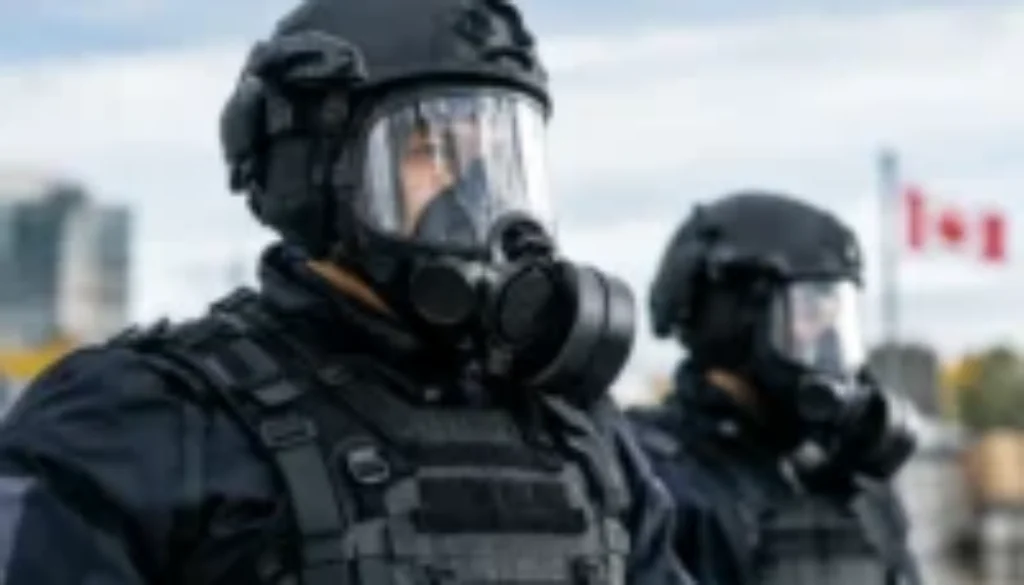
The facepiece determines whether the system can seal against the wearer’s skin. Full-face masks are commonly considered for riot-control duties because they protect the eyes as well as the respiratory tract from airborne irritants. That added coverage brings trade-offs: more weight, heat buildup, possible lens fogging, and a greater need to confirm compatibility with helmets, radios, hearing protection, and other issued equipment.
Sizing should be treated as a safety requirement, not a comfort preference. A facepiece that is too large may shift during movement. One that is too small can create pressure points, interfere with speech, and prevent a consistent seal. Users should follow the manufacturer’s sizing guidance and complete formal fit testing where required by their employer or governing safety program.
Facial hair is a frequent point of failure. Beards, heavy stubble, and any material that crosses the sealing surface can compromise a tight-fitting respirator. Eyeglass temples can do the same. Personnel who require corrective lenses should use an approved spectacle insert or a mask-compatible optical solution rather than placing standard eyewear beneath the seal.
A user seal check before each use is valuable, but it does not replace fit testing. Fit testing verifies that a specific model and size can achieve an acceptable seal for the individual wearer. A quick field check helps identify an obvious problem before leaving a controlled area. Both have a place in a professional respiratory-protection program.
Filters and Cartridges Require Exact Compatibility
A high-quality facepiece cannot compensate for the wrong cartridge. Before procurement, confirm the mask’s connector standard and the specific cartridges approved for that platform. Some systems use standardized threaded connections, while others use proprietary bayonet or quick-connect designs. Interchanging components across brands without documented compatibility is not a sound safety practice.
Cartridge selection also has a service-life component. Filters do not last indefinitely once opened and exposed to contaminants, humidity, or normal handling. Their useful life depends on the hazard concentration, humidity, breathing rate, temperature, storage history, and the manufacturer’s stated limitations. There is no universal replacement interval that can be applied to every operational setting.
For this reason, organizations should establish a written change schedule based on the anticipated hazard and cartridge guidance. Individual users should also know how to inspect seals, housings, and inlet covers before use. A damaged gasket, cracked cartridge body, missing plug, or expired component should remove the item from service until it can be evaluated and replaced.
Visibility, Communication, and Mobility Matter
Respiratory protection cannot become the weak point in the rest of the protective ensemble. A wide, impact-resistant lens supports peripheral awareness, but lens geometry must still work with the wearer’s helmet and eye protection requirements. Test the full configuration rather than evaluating each item in isolation.
Communication deserves equal attention. A full-face mask changes voice projection and can make radio transmission less intelligible. For team environments, consider masks with compatible voice diaphragms or communications interfaces, then test them with the radios, microphones, headsets, and push-to-talk units actually used on duty. Equipment that works on a product bench may perform differently when the wearer is moving, breathing heavily, or working in a noisy environment.
Field of view, weapon stock weld, shoulder mobility, and access to identification equipment should be checked during controlled training. The goal is not to turn training into a product demonstration. It is to identify fit conflicts before equipment is relied upon in a stressful incident.
Inspection and Storage Protect the Investment
Respirators are protective equipment with consumable components, not items to leave in a vehicle or equipment locker until an incident occurs. Heat, ultraviolet exposure, compression, oils, solvents, and poor storage conditions can degrade rubber compounds, lenses, valves, and cartridge seals. Store the mask according to manufacturer instructions in a clean, dry location, protected from direct sunlight and physical damage.
Before issuing or wearing a mask, inspect the lens for cracks and deep scratches, the seal for tears or distortion, the straps for elasticity, the inhalation and exhalation valves for damage, and the cartridge connection for contamination or missing parts. Keep filters sealed until needed when the manufacturer permits sealed storage. Record inspection dates and replacement actions so that equipment status is clear across a team.
After exposure, follow the manufacturer’s cleaning and decontamination instructions. Avoid unapproved cleaners, petroleum products, and abrasive materials that can cloud the lens or damage elastomer components. If the mask cannot be confidently returned to service, it should be removed from the operational inventory until qualified personnel inspect it.
Procurement Should Account for the Full Program
The lowest initial price is rarely the real cost of a respirator program. Procurement should consider replacement lenses, valves, harnesses, approved cartridges, spectacle inserts, storage solutions, communication accessories, and training requirements. A platform with reliable parts availability may be the stronger long-term choice even when its initial cost is higher.
For private security, emergency-response organizations, and qualified civilian buyers, legal and policy requirements matter as much as product specifications. State and local restrictions, workplace rules, event policies, and organizational procedures can affect when and how protective equipment is carried or used. Buyers should confirm those requirements before purchase and ensure that any equipment program has clear accountability for issue, inspection, and replacement.
CANARMOR approaches protective equipment as a mission-readiness decision: verify the protection category, confirm the fit, document the equipment condition, and maintain the system for its intended use. That standard applies whether a buyer is equipping one trained professional or managing a larger security inventory.
A Practical Pre-Use Check
Before a mask is relied on, the wearer should be able to answer five direct questions:
- Is this the correct facepiece size and has it been fit tested where required?
- Is the cartridge approved for this mask and suitable for the expected hazard?
- Are the cartridge, valves, lens, seal, and straps free of damage or expiration concerns?
- Does the mask work with the helmet, eye protection, communications gear, and other assigned equipment?
- Has the wearer completed the organization’s required training and inspection process?
If any answer is unclear, the equipment is not ready for duty. Resolve the issue in a controlled setting, with proper guidance and replacement parts available.
The right gas mask is not defined by appearance or a single feature. It is the one that fits the individual wearer, uses documented compatible filtration, remains maintained between assignments, and performs as part of the complete protective system. Treat that decision with the same discipline applied to every other piece of life-safety equipment.