Stab Resistant Vest Guide: Standards, Materials, and How To
What should a buyer trust first, the label on the vest, or the marketing language around it? In the stab armour world, that's the wrong starting point. A stab resistant vest is a purpose-built torso armour system designed to resist knives, spikes, shanks, and similar pointed or edged threats, and it's measured by penetration performance, not by vague promises of being “strong” or “heavy-duty.” That matters in Canada because stab protection and ballistic protection solve different problems, and CANARMOR fits into that distinction as a Canadian source for armour that needs to be chosen by threat, fit, and standard, not by guesswork.
Table of Contents
- What a Stab Resistant Vest Actually Does
- How Stab Protection Differs From Ballistic Armour
- Inside the NIJ Stab Resistance Standard 0115.00
- Materials and Construction Behind Stab Panels
- Matching Vest Levels to Real Canadian Roles
- Choosing the Right Fit, Carrier, and Coverage
- Canadian Legal and Procurement Considerations
- Care, Service Life, and Verification FAQ
What a Stab Resistant Vest Actually Does
What should a stab resistant vest do, in plain terms? It is built to slow or stop a concentrated blade or spike to keep it from reaching the torso, with coverage focused on the front, back, and sides where the chest and internal organs need protection. That focus matches how stab threats usually arrive, under clothing or over clothing depending on the model, and in a form that tries to slip through gaps in ordinary soft armour. Stab protection is a torso-specific engineering problem, not a general “body armour” label.
The threat is shaped, not spread out
A knife edge behaves differently from a bullet impact. The threat may be a slashing motion, a stabbing motion, a single-edge blade, or a spike-like point, and each one changes how force enters the vest. NIJ's stab-resistance framework was built to protect law-enforcement and corrections personnel against knives, spikes, and similar threats, and it separates covert use from overt use, with Level 1 generally concealable, Level 2 suited to general-duty extended wear, and Level 3 used when risk is higher and visibility is less of a concern (Public Safety Canada PDF).
That distinction is easy to miss if you have only shopped for “body armour” in the broad sense. The right vest depends on how the threat behaves and how long the wearer must keep it on. A brief security assignment, a corrections shift, and patrol duty in a high-risk setting do not call for the same setup.
Practical rule: if the product description talks only about thickness or “bulletproof” protection, keep reading. Thickness alone does not tell you how the vest handles a blade tip.
For lone workers, outreach staff, and other people who may be working with limited backup, the protection conversation also has to include workflow and incident response. A useful non-armour resource for that wider context is the guide to protecting lone workers, especially when the job mixes unpredictable contact with delayed assistance.

What it protects, and what it doesn't
A properly specified vest is meant to reduce penetration from edged and pointed weapons. It does not protect against every threat a wearer may face. The standardised stab-and-puncture category was formalised in 2000, replacing marketing language with testable performance levels and documented use cases (CJTTEC body armour overview).
That is the simplest working definition buyers should keep in mind. If the garment does not clearly state the stab standard it is built to, and if it does not match the wearer's threat environment, it is not the right vest.
How Stab Protection Differs From Ballistic Armour
Ballistic armour and stab armour often get grouped together, but they solve different problems. A bullet impact spreads force across a different kind of strike than a knife point, and that difference changes the fibre layout, laminate structure, and the standard a vest needs to meet. A panel that performs well against handgun threats can still be the wrong answer for a sharpened screwdriver or shank, because the load is driven through a very small point instead of across a wider impact face.
Concentrated load versus distributed impact
Ballistic soft armour is usually designed to deform and absorb energy from a projectile. Stab resistance needs a different structure, one that stops a point from pushing through the panel and separating the fibres. In practice, knife and spike resistance often relies on tighter weave, laminate layers, or chainmail-like reinforcement in some multi-threat designs.
The practical takeaway is straightforward. IIIA or other ballistic labels do not automatically include stab protection. Canadian agencies and security teams should ask for the test report and labels for both the carrier and insert, then verify the stated stab standard before purchase, because “bulletproof” and “stab resistant” are different claims with different test methods. A hard rule I use in fittings is simple, if the document does not name the stab standard, the buyer does not yet know what the vest was built to stop.
Here's the confusion point I see most often when fitting vests. People assume the heavier-looking panel must be better at everything. It is not. A ballistic stack can be very good at handgun threat reduction and still be the wrong material architecture for blade resistance.
CANARMOR's Concealeable Coverts are listed as ballistic concealeable body armour vests, which is useful to know, because “concealable” describes wear style and coverage, not automatic stab certification.

Why the difference matters in the field
The reason this matters is operational, not academic. If a security team buys the wrong kind of armour, it may end up with a vest that feels protective but has never been tested against the actual threat. Injury research has also shown that stabbing remains a meaningful mechanism of harm, even as newer materials reduce penetration risk, which is why armour cannot be treated as one category for every threat.
That is why I tell buyers to read the standard first and the sales copy second. If the product cannot clearly separate ballistic performance from stab performance, it is probably not the product you need.
Inside the NIJ Stab Resistance Standard 0115.00
What does a stab resistant vest have to prove before a buyer should trust it? NIJ 0115.00 answers that question with a pass-fail test, not a marketing claim. The standard sets out strike energy, strike angle, and allowable penetration, so procurement teams can compare products on the same terms instead of trying to interpret soft language on a brochure.
The numbers that actually matter
NIJ Standard-0115.00 separates threats into knife and spike, then tests them across three energy levels. The measured strike energies are 24±0.50 J, 33±0.60 J, and 43±0.60 J, with overtests at 36±0.60 J, 50±0.70 J, and 65±0.80 J respectively (NIJ Standard 0115.00 PDF).
The pass criteria are tight, and that is the point. For E1 strikes at 0° and 45°, penetration must not exceed 7 mm. For E2 strikes at 0°, maximum penetration is 20 mm. Earlier Public Safety Canada material describes the same general framework in plain language, including the older PSDB guidance that used 43 joules with no more than 7 millimetres of penetration for the highest tier, plus a 50% overtest at 65 joules allowing no more than 20 millimetres of penetration.
Those are not suggested targets. They are the gates a vest must clear.
| Threat Level | Strike Energy | Overtest Energy | Max Penetration (E1) | Max Penetration (E2) |
|---|---|---|---|---|
| Level 1 | 24±0.50 J | 36±0.60 J | 7 mm at 0° and 45° | 20 mm at 0° |
| Level 2 | 33±0.60 J | 50±0.70 J | 7 mm at 0° and 45° | 20 mm at 0° |
| Level 3 | 43±0.60 J | 65±0.80 J | 7 mm at 0° and 45° | 20 mm at 0° |
How to read the levels in real life
The levels map to use style. Level 1 is generally concealable, Level 2 fits general-duty extended wear, and Level 3 is usually worn overtly in higher-risk situations. That helps explain why the highest number is not always the right answer. A lower-profile vest that gets worn all shift can protect better in practice than a heavier model that ends up left in a locker.
A good test result only helps if the vest matches the job.
A buyer who understands this standard can ask better questions. Is the panel certified to a stab standard, or is it only a ballistic product with similar-looking marketing? Does the documentation show knife and spike performance, or just a general claim about protection? That is the sort of detail that separates real stab resistance from a vague promise.
Materials and Construction Behind Stab Panels
Once you know what the vest has to do, the next question is how it does it. Stab panels are built around materials that resist penetration, spread force, and keep the panel wearable enough for real shifts. The exact stack varies by product, but the design goal stays the same, stop a pointed object from concentrating enough energy into one spot to get through.
The main material families
High-tenacity aramid fibres are common in protective panels because they offer strong resistance in a light, flexible format. UHMWPE is another widely used family in ballistic and some multi-threat constructions, although the blade-resistant layout still has to be engineered for the threat geometry rather than assumed from the fibre name alone. In some designs, manufacturers add laminate layers or metallic chainmail-style inserts to help blunt spikes and reduce penetration risk.
Those combinations are why stab panels can feel very different from one another when you handle them. Some are soft and flexible, others are stiffer because the panel needs more structure to defeat a point load. Hybrid multi-threat panels go one step further by combining stab and ballistic layers, but that usually means more thickness and more heat retention.
What the buyer should look for
The labels matter as much as the materials. A panel built from aramid might still be a poor choice if it isn't tested to the right stab standard. A ballistic insert might be excellent for handgun threats and still not be enough for knife or spike protection unless the product is explicitly certified for that use.
Practical rule: never assume a material name equals a threat rating. Ask for the standard, then ask for the panel structure.
For buyers who want to understand fibre behaviour in more detail, CANARMOR's overview of What Is Kevlar is a useful technical starting point. It's especially helpful if you're comparing aramid-based panels with other soft-armour constructions.
A final point on construction, because it gets overlooked. The best panel on paper still has to be wearable in motion. If the design traps too much heat or fights the wearer's movement, the end result is weaker in practice than a simpler panel that gets used properly.
Matching Vest Levels to Real Canadian Roles
Canadian buyers usually do not shop for armour in the abstract. They shop for a job. That is why the same stab-resistant level will not suit every role, even when the vest itself is built well. The key question is how much protection the wearer needs, and how much bulk the job can tolerate.
Role to risk, then risk to vest type
For corrections officers, the threat profile often justifies a higher stab-resistance level and, in many settings, overt coverage. The vest has to handle close-contact incidents and repeated wear in the routine of the job. For frontline police patrols, the right choice often depends on local assignment and on whether edged-weapon contact is a realistic concern or just one risk among several.
Private security and loss-prevention staff often need a lighter, more concealable setup, especially if the armour must sit under a uniform. Healthcare and outreach workers in higher-risk settings usually need comfort, concealability, and enough protection for unpredictable close contact. Journalists, bailiffs, and bylaw officers may need something between those extremes, depending on how often they face confrontational access points or crowd situations.
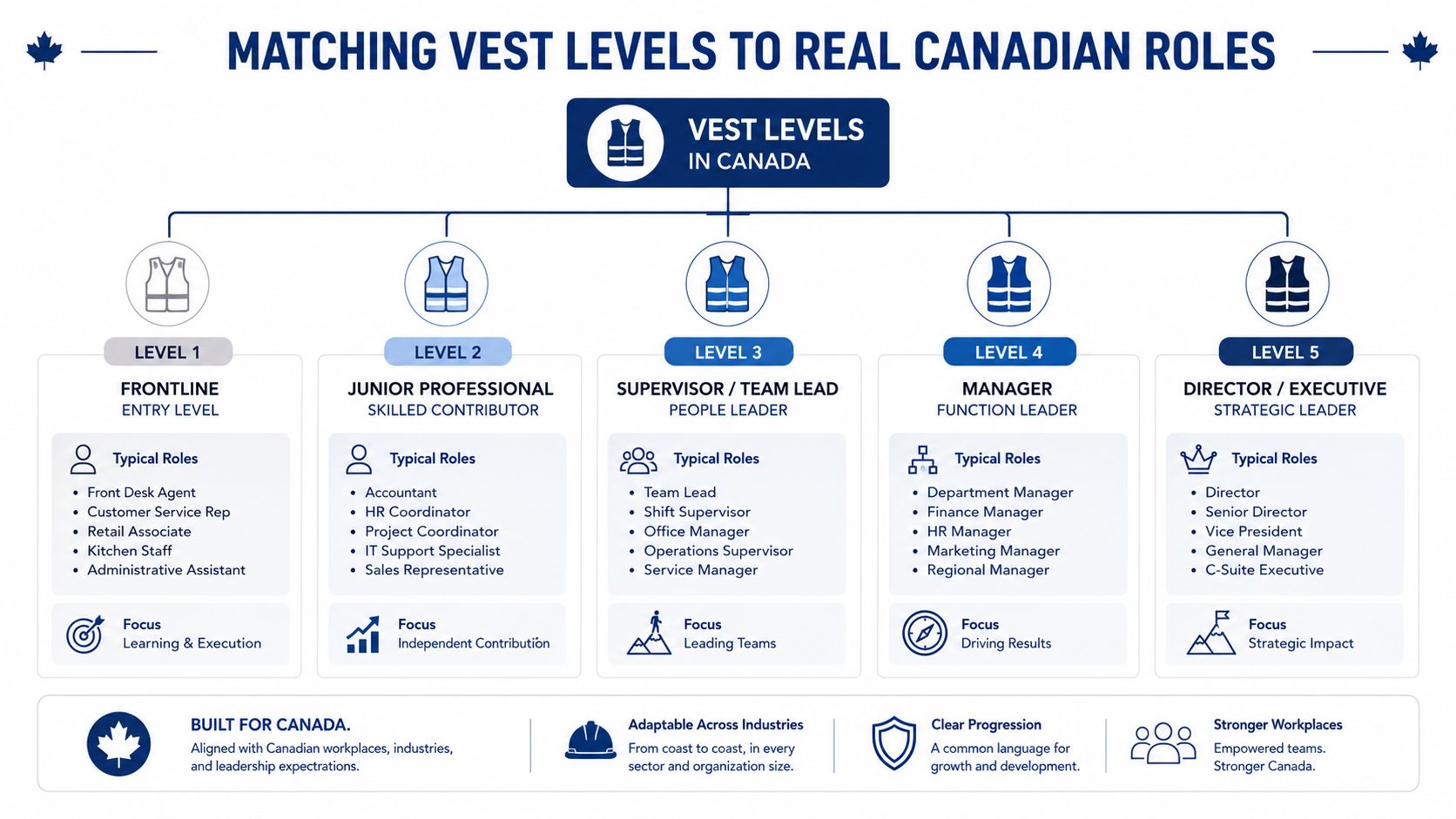
The NIJ level descriptions give a useful shorthand here, but they should be read as a guide to the threat, not as a substitute for the stab standard on the label. A lower-profile vest may be easier to wear every day, while a higher-profile vest may make more sense when the role puts the wearer in closer contact and the carrier can handle the added bulk. For a clear visual overview of how vest levels are matched to job progression, see An infographic titled Matching Vest Levels to Real Canadian Roles, detailing career progression levels from one to five.

Choosing by workflow, not just by title
A role title does not tell the whole story. A bylaw officer who spends most of the day in a vehicle needs different comfort and access than a corrections worker moving through a facility. The same is true for a security guard on a short post compared with a worker who wears armour for long shifts under regular clothing.
That is why I start with workflow. If the vest interferes with driving, reaching, bending, or de-escalation work, the rating alone will not save it. If the vest fits the day, people are more likely to keep it on. For buyers who need a carrier that matches the role and the panel set, a plate carrier vest can be the right starting point when the job calls for a different coverage pattern.
Choosing the Right Fit, Carrier, and Coverage
Fit is where a lot of good armour fails in real use. A vest can have the right rating and still underperform if it rides too high, gaps at the sides, or shifts when the wearer moves. Coverage also matters, because a panel that leaves the chest, back, or side zones poorly protected creates a weak point the standard never intended.
How to judge fit in plain language
Start with the torso, not the tag size. The vest should cover the vital area without digging into the neck or pressing into the stomach when the wearer sits. It also needs enough side coverage for the body type and the daily movements that job requires.
For covert use, the carrier must sit cleanly under clothing without printing badly. For overt use, the focus shifts to access, ventilation, and the ability to carry the panel in a way that doesn't fight the rest of the kit. If the wearer needs plate compatibility, the carrier should be selected with that in mind instead of being modified later.
Here's the buying logic I use with clients:
- Confirm torso coverage: check chest, back, and side fit before looking at accessories.
- Match carrier style to the job: covert for concealment, overt for visibility and layering.
- Check movement first: sit, bend, twist, and reach while wearing the vest.
- Plan for heat: thicker multi-threat panels can feel warmer over long shifts.
- Verify compatibility: make sure the carrier, inserts, and any added plates work together.

The point of overt versus covert
Covert vests help with discretion. Overt vests help with visibility, quick recognition, and often better airflow over a uniform. The wrong choice can make a vest uncomfortable enough that it gets worn less often, and that's a problem no rating can fix.
If you're comparing carriers for law-enforcement-style use, CANARMOR's plate carrier vest and law enforcement vest pages are useful starting points for understanding the difference between carrier styles and use cases. The right match is always the one that fits the task, not just the one that looks more tactical.
Canadian Legal and Procurement Considerations
Canadian buyers should treat stab-resistant armour like any other regulated safety purchase, with paperwork checked before payment. The legal rules can vary by province, especially when possession, occupational use, or eligibility are involved, so the first step is always to confirm local requirements before procurement. Law enforcement, corrections, security, and civilian users may all face different practical and legal pathways.
What to ask for before you buy
A serious buyer should request a current test certificate that names the exact stab standard. Ask for the labels on both the carrier and insert, because a labelled carrier can still hold an untested or mismatched panel. Also ask for the lot or serial number and the warranty information, so the product can be traced and supported if there's a question later.
That request becomes even more important when the vest is being bought for volunteers, contractors, or mixed-use teams. A useful broader screening resource for people checking credentials or volunteer assignments is VolunteerBadge's volunteer background checks, which fits naturally into a procurement process where trust and role clarity matter.
The mistake to avoid
The biggest mistake is assuming an unmarked vest is automatically stab rated because it looks substantial. Independent guidance on buyer verification stresses checking both labels and asking for the test report, because unmarked or vaguely labelled products may only be ballistic, not stab-rated (Protection Group Denmark).
In practice, that means procurement teams should build a simple file for each vest:
- Standard reference: the exact stab standard named in the certificate.
- Label match: carrier and insert labels that agree with the paperwork.
- Traceability: lot or serial number for the actual item received.
- Support terms: warranty and replacement conditions in writing.
That paperwork protects the buyer from the most common failure, buying a vest that sounds right but isn't certified for the threat.
Care, Service Life, and Verification FAQ
A stab vest only does its job if it's kept in serviceable condition. Routine inspection is basic but easy to skip, especially when the vest becomes part of the daily uniform. I tell users to check for broken stitching, crushed panel edges, damaged closures, moisture problems, and any obvious change in fit after cleaning or storage.
Maintenance that helps, not harms
Use gentle cleaning methods that won't degrade the fibres or carrier materials. Don't store the vest compressed, folded tightly, or left in a hot vehicle for long periods. Panels should be kept dry, flat when possible, and protected from rough handling that can bend or crease the insert.
If a vest has been in a verified incident, treat it as a document-and-review event, not a quick wipe-down. The panel may need replacement even if the damage isn't obvious. That's part of responsible ownership, along with checking whether the product is still within the manufacturer's service guidance.
Common questions buyers ask
Does a IIIA vest also stop knives? No. Ballistic ratings and stab resistance are separate regimes, and a handgun-rated vest isn't automatically certified for edged or pointed threats.
How do I confirm a test certificate is current? Match the certificate to the exact product labels, serial or lot number, and the named standard. If any of those don't line up, treat it as unresolved.
What adds value over time? Services like sizing appointments, support after an incident, and trade-in options can make long-term ownership easier because they help the wearer stay in the right size and the right protection class.
Should I keep using a vest after a stab event? Only after it's been reviewed against the manufacturer's guidance and any applicable incident documentation.
A good vest is only good if it keeps being worn correctly, inspected regularly, and replaced at the right time.
A CTA for CANARMOR. If you're comparing stab resistant vests for a specific Canadian role, start by reviewing the product labels, the test standard, and the carrier style that matches the job. Then contact CANARMOR for sizing guidance, technical specification review, or a procurement discussion that separates stab protection from ballistic protection before you order.